
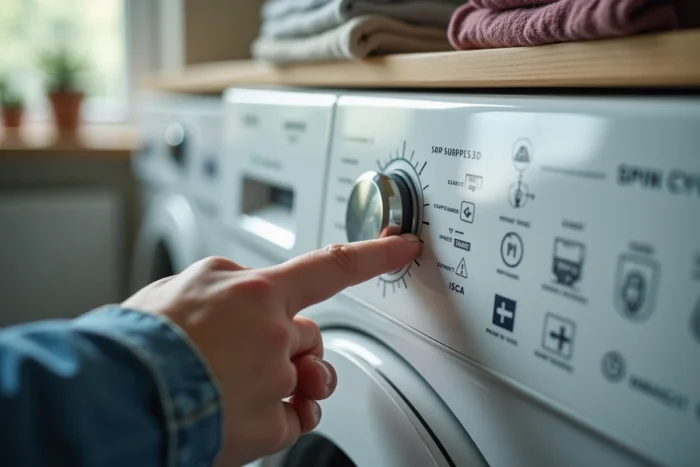
On a Valberg washing machine, the spin icon takes the form of a spiral printed on the control panel or displayed on the screen. This symbol controls the rapid rotation of the drum that extracts residual water from the laundry after the washing cycle. Depending on the model, the spiral may appear alone, associated with a speed dial, or integrated into a combined selector that groups several functions on the same rotary button.
Variations of the spin symbol according to Valberg models
The spin signage is not identical from one Valberg appliance to another. Machines equipped with a digital screen generally display the spiral accompanied by a number indicating the drum’s rotation speed. Models without a screen use a combined selector where the spiral is among other pictograms engraved around the rotary button.
This diversity of presentation explains a significant part of the confusion. A user transitioning from a recent front-loading model to an older model may not find the same visual reference. Identifying the type of control (dedicated button, combined selector, digital touch) is the first step to mastering Valberg spin pictograms on your appliance.
One particular pictogram deserves attention: the crossed spiral. It indicates the complete removal of the spin cycle, a distinct option present on some Valberg control panels. Activating this function prevents the drum from spinning at high speed at the end of the cycle, leaving the laundry soaked in water in the drum.
Spin speed and textile labels: the link to check
Each spiral pictogram corresponds to a range of speeds expressed in revolutions per minute. The higher the selected speed, the more water the drum extracts, and the drier the laundry comes out. The direct trade-off: the fibers undergo greater mechanical stress.
The care label sewn into a garment provides additional information. A square with a circle inside, crossed by a line, means that machine drying is prohibited, which also suggests limiting the spin speed. Delicate textiles (silk, wool, lace) do not withstand fast spinning well.
Practical correspondence between textiles and settings
- Thick cotton, towels, sheets: maximum speed offered by the machine, the fabric withstands centrifugal force well and comes out almost dry.
- Synthetics, polyester, sportswear: intermediate speed, as these fibers wrinkle more under too fast a spin and retain little water anyway.
- Wool, silk, delicate lingerie: crossed spiral or minimum speed, to avoid felting or fiber deformation.
Checking the textile label before confirming the program avoids unpleasant surprises. The spin pictogram on the machine does not replace reading the garment’s label: both pieces of information work together.
Valberg combined selector: reading the panel without a manual
On Valberg models without a screen, the panel groups the pictograms around a single rotary selector. Each position of the button activates a complete program that includes a predefined spin level. The spiral does not appear as an isolated command but as an engraved reference among other symbols (water basin for washing, droplet for rinsing).
To change the spin speed on this type of panel, you often need to press a secondary button after positioning the selector. This operation is not always intuitive. The secondary button usually features the spiral in smaller size, sometimes accompanied by up/down arrows.

On screen models, the process is more straightforward: a dedicated button allows you to scroll through the speed levels. The screen then displays the corresponding number. Pressing this button multiple times also reveals the “no spin” option (crossed spiral or display of a zero).
Quick reading tip for the panel
First, locate the spiral on the panel, then identify whether it is engraved on the main selector or on a separate button. If it is on the selector, the spin speed depends on the chosen program. If it is on a separate button, the spin speed is adjusted independently of the washing program.
Valberg spin and preventive maintenance of the washing machine
A spin that seems less effective than when purchased does not necessarily indicate a motor failure or an electronic defect. Recent maintenance guides first direct attention to checking the drain filter and the drainage circuit.
A clogged drain filter prevents water from flowing properly before the spin phase. The drum then spins in a drum that is still partially filled, which reduces the efficiency of extraction. The laundry comes out wetter, and the user may believe that the spin program is malfunctioning.
- Check the drain filter every two months by unscrewing it (trap at the bottom right or left of the machine depending on the Valberg model).
- Ensure that the drainage hose is not bent or blocked, as poor drainage slows down the emptying process.
- Observe if the machine vibrates abnormally during spinning: an imbalance in load (laundry poorly distributed in the drum) can sometimes trigger an automatic reduction in speed.
This preventive maintenance logic extends the lifespan of the appliance and maintains the spin performance indicated by the selected pictogram.
The spiral pictogram on a Valberg washing machine summarizes a precise mechanical function, but its shape and location vary from model to model. Systematically cross-referencing the machine setting with the textile label of the garment remains the most reliable method to protect the laundry while achieving an appropriate spin.