
Are you looking for a comfortable pair of sandals and are torn between Scholl and Birkenstock? Both names are everywhere, often confused, sometimes opposed. The choice between these two brands is based on concrete differences in construction, materials, and everyday use.
Scholl sole vs. Birkenstock sole: two philosophies of comfort
Before comparing styles or prices, look under the shoe. It’s the sole that determines the sensation underfoot, and the two brands have different approaches.
Birkenstock uses an insole made of cork and natural latex. This cork gradually molds to the shape of your foot’s arch. After a few days of wear, the sole retains the imprint of your foot. The result: a support that adapts to your morphology over time.
Scholl comes from an orthopedic heritage. The brand offers pre-formed insoles, often made of wood or composite materials, designed to provide immediate support from the first wear. No break-in period, comfort is calibrated right out of the box. However, the sole does not customize to your foot in the same way.
A detailed comparison of Scholl and Birkenstock allows for a better visualization of these design differences that guide your choice based on your priorities.
Do you spend the day standing in a service job? Scholl’s immediate response may suit you. Do you walk a lot on vacation and prefer a sandal that molds to your feet over time? The cork of Birkenstock makes perfect sense.
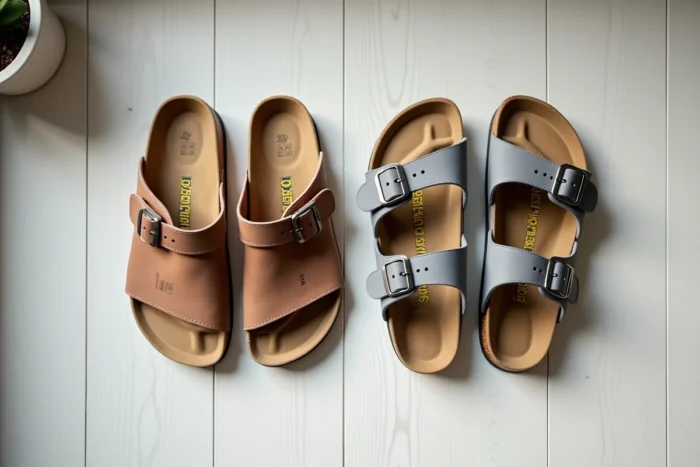
Leather, cork, wood: materials that change durability
The lifespan of a sandal directly depends on what it is made of. In this regard, Scholl and Birkenstock play different cards.
Birkenstock cork and its longevity
The cork in Birkenstock can last several years with minimal maintenance. The brand highlights the possibility of resoling on certain models. Well-maintained cork extends the lifespan of the sandal by several seasons. The leather used for the straps (on models like Arizona or Gizeh, for example) ages beautifully with a patina.
Wood and certified materials from Scholl
Scholl uses wood sourced from sustainably managed forests on its rigid-soled models. The brand’s iconic clogs and mules are built on this foundation. The materials for the straps vary more: leather, synthetic, or fabric depending on the ranges.
The arguments for durability do not rely on the same levers: longevity of cork and recyclability at Birkenstock, traceability of raw materials at Scholl. Neither brand publishes a complete carbon footprint report, but both are taking steps in this direction.
Trendy sandals or functional sandals: when to wear what
Have you noticed that Birkenstock appears in fashion collaborations while Scholl is often associated with the parapharmacy section? This perception is changing, but it reflects a reality of positioning.
Birkenstock has built a lifestyle image. The brand has collaborated with fashion houses and regularly appears in trend selections. The double-buckle Arizona has become a classic worn both in the city and at the beach.
Scholl occupies a hybrid space. The brand oscillates between orthopedics and fashion, with recent collections incorporating more refined lines. Scholl mules, once limited to indoor use, are now worn outdoors in bold looks.
To choose, ask yourself a simple question: how will you wear this sandal?
- In city attire with jeans or a dress: smooth leather Birkenstock models (Gizeh, Madrid) easily integrate into a polished casual style
- At the office or in a standing professional environment: Scholl wooden-soled clogs provide firm support and a discreet look suited for these contexts
- On vacation for long walks: the Birkenstock cork with its ability to adapt to the foot remains the most logical choice for prolonged comfort
- At home or for mixed indoor/outdoor use: Scholl slip-on mules fulfill this role effortlessly
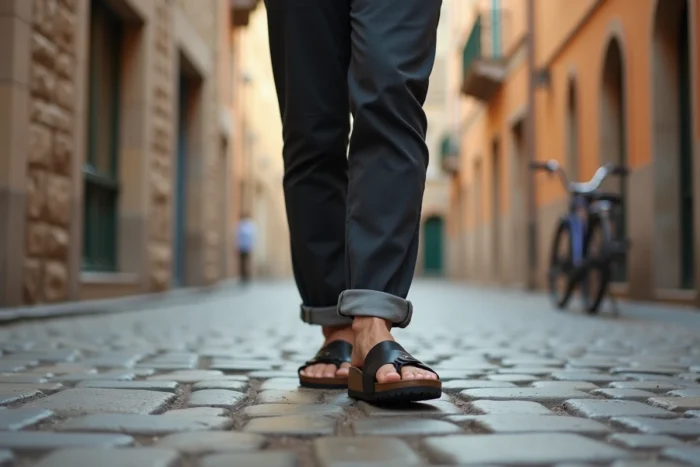
Budget for Scholl and Birkenstock sandals: where does your money go
Both brands fall within a mid to high price range, but the budget distribution is not the same.
At Birkenstock, the price mainly reflects the cost of natural cork and leather. Entry-level models in EVA (synthetic foam) are significantly cheaper than the leather versions. The price difference between an Arizona EVA and a leather Arizona is substantial.
At Scholl, the range is broader. Basic mules remain affordable, while models with wooden soles and leather straps increase in price. The brand also offers foot care ranges (creams, accessories), which sometimes muddles the overall price perception.
A point often overlooked: the real cost is calculated over the duration of use. A Birkenstock worn for three summers costs less per season than a sandal replaced every year. The possibility of resoling on certain Birkenstock models further extends this calculation.
Foot size and shape: the criterion no one should ignore
Birkenstock offers two widths for most of its models: regular (standard to wide foot) and narrow (slim foot). This option radically changes comfort for people with narrow or wide feet.
Scholl generally offers only a standard width. If you have particularly wide or very narrow feet, check the availability of widths before purchasing.
The arch also plays a role. The pronounced arch of Birkenstock may not suit all flat feet, at least initially. Scholl, with its orthopedic approach, offers models with more neutral support, sometimes better tolerated right away by flat feet.
The best criterion remains the one you can test: try both, walk for ten minutes, and compare the sensation under the arch and at the toes. No comparison can replace this direct verification.