When replacing a door handle or leveling a shelf, one doesn’t necessarily think about DIY trends. The market, however, is moving quickly: a decline in large renovation projects, an increase in compact cordless tools, and a demand that is refocusing on maintenance rather than heavy projects. These shifts are concretely changing what is available on the shelves and what is worth buying.
Routine maintenance versus heavy renovation: the shift that no one anticipated
Since 2023, sales at large DIY stores have been declining. The slowdown in real estate transactions and the drop in new housing are prompting households to postpone heavy renovation projects. According to the 2024 barometer from the Federation of DIY Stores (FMB) and Inoha, demand is shifting towards maintenance, repairs, and replacement of existing items.
Specifically, people are buying more consumables, spare parts, and maintenance products. Less solid wood flooring to install in a living room, more faucet seals to change on a Sunday morning. This shift modifies the depth of product ranges in stores: brands are highlighting repair kits, technical adhesives, and versatile small tools rather than large machines.
For DIY enthusiasts, this is good news: manufacturers are investing in more accessible products that are better designed for occasional interventions. Following the news on the Univers du Bricolage website allows you to spot these developments before heading to the checkout.
Compact cordless tools: what is really changing on the ground
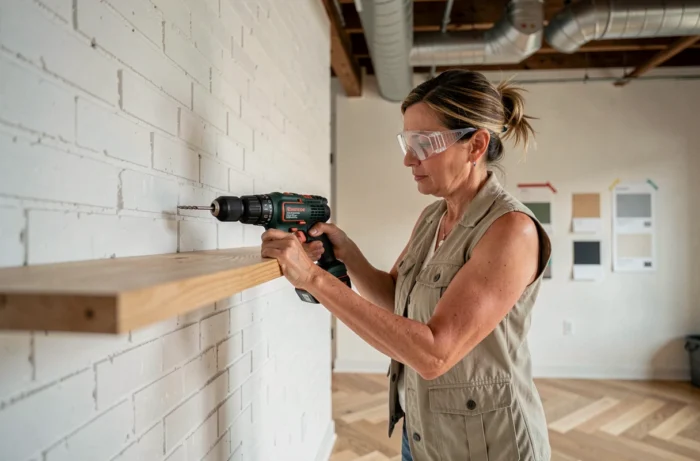
The compact multifunction tool dominates sales in 2026. This is no coincidence: it meets a way of DIY that prioritizes versatility over raw power.
Why the compact format is taking over
A downtown apartment, a shared garage, a balcony turned into a workshop: DIY spaces are shrinking. A compact, cordless tool solves both a space issue and a technical problem. Beginners find a non-intimidating first tool, while experienced DIYers see it as a complement for everyday tasks.
Manufacturers are adapting their professional technologies into consumer ranges. We now have impact drivers, sanders, and trimmers that are more compact without sacrificing reliability. Feedback varies on the lifespan of entry-level batteries, but platforms with interchangeable batteries (where the same battery powers multiple tools) reduce overall costs.
Concrete criteria for choosing a cordless tool in 2026
- Battery compatibility: check that the battery works with other tools from the same brand to avoid accumulating unnecessary chargers
- Noise level: recent ranges incorporate significantly quieter brushless motors, a decisive point in apartments or condominiums
- Weight in hand: under one kilogram for a drill, fatigue during a two-hour session remains manageable, even for occasional use
- Availability of consumables: a multifunction tool is worthless if replacement blades or bits are not locally available
Before buying, it’s wise to check that the tool fits into a battery ecosystem you already own. The extra cost of an additional battery can represent half the price of the device.
Quiet and clean DIY: a constraint turned selling point
We talk less about batteries or connected applications, but noise and dust are the two main reasons for abandoning an indoor DIY project. Manufacturers have understood this.
Brushless motors significantly reduce noise pollution compared to brushed motors. On an orbital sander, the difference is immediately noticeable, especially in poorly sound-insulated homes.
On the dust front, integrated dust extraction systems are improving. We now find sanders and circular saws with standardized vacuum connections, eliminating the need for DIY solutions (duct tape, 3D printed adapters). This is not a gimmick: working in a clean space reduces cleaning time and limits exposure to fine particles.
Distribution and pricing: how DIY stores are adapting to the market decline
The paradox of the sector: stores continue to open and increase their retail space even as the market declines. This strategy relies on a bet on proximity. Rather than concentrating supply in large peripheral stores, several players are betting on smaller formats that are closer to urban centers.
For the DIY enthusiast, this evolution has concrete effects:
- Proximity stores with a tighter but better-targeted assortment of maintenance and small renovation products
- A rise in online sales with in-store pickup, allowing verification of availability before traveling
- More aggressive pricing policies on consumables and small tools, where turnover is rapid
Price remains the primary purchasing criterion for the majority of consumers, but immediate product availability is increasingly influencing the decision. A product in stock ten minutes from home often outweighs an online promotion delivered in five days.
Durability and repairability: beyond marketing talk
Manufacturers are communicating about the durability of their products, and some are genuinely making progress. The repairability index, mandatory in France for several categories of devices, is starting to influence choices on the shelves. A tool with a high score indicates that spare parts are available and that disassembly is planned from the design stage.
On the ground, we see that mid-range products are improving in this area. Screwed casings are replacing clipped or glued casings, batteries remain removable, and disassembly instructions are sometimes available online. This is not yet widespread, but the trend is clear.
DIY in 2026 is not just about more efficient tools. It reflects a change in the relationship to housing: we repair more than we transform, we seek efficiency in a reduced format, and we weigh options between price, proximity, and lifespan. The innovations that matter are those that respond to these everyday trade-offs, not those that stack functions on a technical sheet.