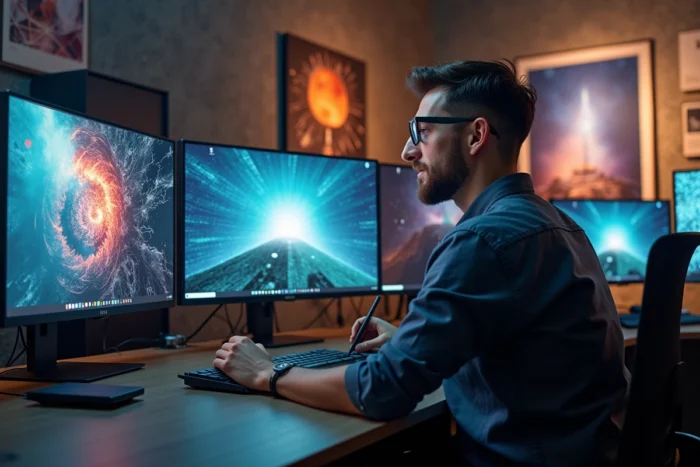
You may have already come across one of his compositions on Instagram or in a virtual gallery without knowing his name. Trixhentzi is a digital artist whose work primarily circulates online, on social media and Web3-related platforms. His journey illustrates a recent phenomenon: creators who build a solid reputation without going through the traditional circuits of contemporary art.
Trixhentzi and visibility outside institutional circuits
Major art journals and French academic databases hardly mention Trixhentzi. This does not reflect a lack of quality, but rather a different mode of dissemination. While a classical painter seeks a physical gallery and then a recognized critic, Trixhentzi builds his reputation through online communities, drops on NFT marketplaces, and collaborations directly visible on social media.
This operation is far from anecdotal. Recognition comes through alternative circuits such as Web3 platforms, specialized Instagram accounts, and collectors active in crypto-art. A detailed article also explores Trixhentzi’s digital art on BreizhPower – The 100% Breton magazine! and helps better understand the mechanisms behind this influence.
The concrete result: an artist can today reach thousands of people, sell works, and be cited by other creators without any museum institution having validated their work. This gap between real visibility and academic visibility is a structural characteristic of contemporary digital art.
Crypto-art and the redistribution of value for digital artists
You have probably heard of NFTs as a speculative bubble. This reading is outdated. In recent years, crypto-art has been analyzed as a tool for redistributing value in favor of the artists themselves, rather than just a volatile market phenomenon.
The principle is simple. An artist like Trixhentzi can certify a work via the blockchain, sell it directly to a collector, and then automatically receive royalties on each subsequent resale. This mechanism, known as automatic royalties on the blockchain, profoundly changes the relationship between creator and market.
What this concretely changes for an artist
- The elimination of intermediaries (galleries, agents) reduces the share taken from each sale and gives the creator direct control over the dissemination of their work.
- Royalties programmed into the smart contract ensure a recurring income, even years after the first transaction.
- The public traceability of each work on the blockchain creates a verifiable history that strengthens buyer trust.
For a digital artist working outside physical galleries, this economic model replaces the traditional representation system. It is no longer about waiting for an art dealer to decide to exhibit you, but about directly offering your catalog to an engaged community.
Contemporary digital art: why Trixhentzi embodies a generational shift
Digital art is no longer a niche reserved for technology enthusiasts. Recent reports on the art market show that digital works now represent the third largest expenditure category for major collectors, after painting and sculpture. This hierarchy, unimaginable just ten years ago, places artists like Trixhentzi in a rapidly structuring segment.
Why talk about a generational shift? Because current digital artists do not merely transpose classical techniques onto a screen. They use native tools (3D modeling, algorithmic generation, real-time animation) and publish on native platforms (social media, decentralized platforms).
A different relationship with the audience
The relationship between Trixhentzi and his audience operates in a short loop. An Instagram post can generate immediate feedback, guide the next creation, trigger a sale. The audience actively participates in the creative process through their reactions and shares, which does not exist in the gallery-exhibition-catalog circuit.
This proximity also produces a loyalty effect. Collectors who follow a digital artist on social media develop an attachment to their visual universe even before buying a piece. The storytelling around each work (creation process shared in stories, making-of videos) becomes a component of perceived value.
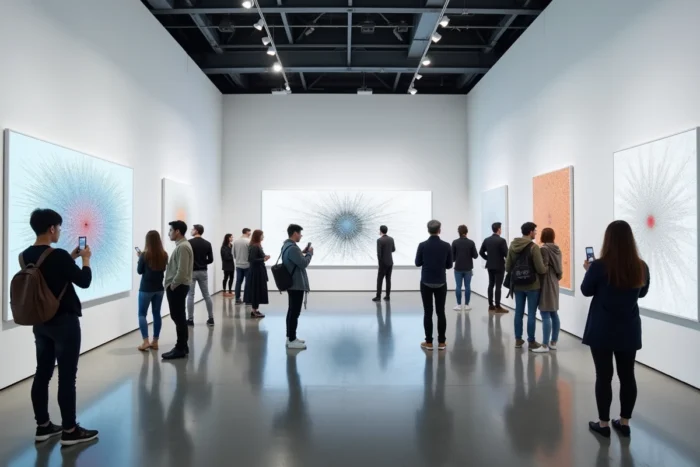
Expertising a digital work: the challenge of authentication
Buying a physical work involves familiar reflexes: certificate of authenticity, provenance, condition. With digital art, the question of expertise arises differently. A file can be copied identically, which makes the notion of originality more complex.
The blockchain provides a partial answer. It proves that a specific version of a file was certified by the artist at a given date. However, it does not guarantee that the work is original in the creative sense. Recent analyses estimate that a significant proportion of NFTs in circulation raise questions of authenticity or copyright.
- Verify that the wallet (digital wallet) that created the NFT is indeed that of the artist, cross-referencing with their official accounts.
- Examine the transaction history on the blockchain to identify any anomalies (too rapid resales, inconsistent prices).
- Consult specialized communities that document counterfeits and fraudulent projects.
For an artist like Trixhentzi, whose reputation relies on a verifiable online presence, the consistency between social accounts and wallet constitutes the first proof of authenticity. This is a simple criterion but often overlooked by novice buyers.
Contemporary digital art is gradually structuring itself around these new practices of authentication and dissemination. Trixhentzi, through his positioning between visual creation and the Web3 ecosystem, represents a generation of artists for whom the gallery is a screen and the market is a connected community.