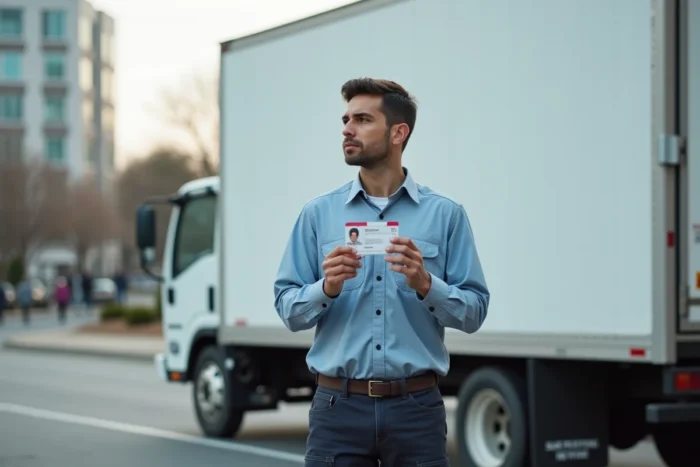
A 12 m³ van remains under the 3.5-tonne GVW limit in almost all configurations offered by French rental companies and manufacturers. The B license is sufficient to drive this type of vehicle, provided that this regulatory threshold is not exceeded. The distinction lies less in the category of the license than in the loading parameters and the validity of the license itself.
Actual GVW of a 12 m³ van: the variable that rental companies do not detail
The volume of the body does not determine the license category. It is the gross vehicle weight (GVW) stated on the registration document (section F2) that decides. A 12 m³ van like the Renault Master, Fiat Ducato, or Mercedes Sprinter generally has a GVW of 3.5 tonnes, which keeps it within the scope of the B license.
However, we observe that some chassis-cab versions with a large volume body may be approved for a higher GVW, sometimes up to 4.5 tonnes. In this case, the B license is no longer sufficient: a C1 license is required, which covers vehicles with a GVW between 3.5 and 7.5 tonnes.
Before any rental or purchase, verification is done on a single document: the registration document. The volume displayed on the body or the rental company’s website has no legal value for determining the license to drive a 12m3 truck in question.
Overloading a 12 m³ utility vehicle: a common offense and penalties

The classic trap with a 12 m³ van is not the license, but the overload. The payload of a 3.5-tonne van is generally around one to one and a half tonnes, depending on the standard equipment (tailgate, double floor, partition). However, an apartment move can easily exceed this threshold if books, appliances, and heavy furniture are stacked.
Exceeding the GVW stated on the registration document constitutes an offense, even if the B license is valid. Weighing checks are frequent on secondary roads and near rental areas. The fine falls under the 4th class, and the vehicle may be immobilized.
Another underestimated point: exceeding the loading at the rear. The Highway Code limits the rear overhang of a load to three meters. Beyond that, the fine escalates to 4th or 5th class depending on the circumstances. Mattresses, boards, and flat-pack furniture protruding from the open tailgate are the most commonly reported offenses for this type of vehicle.
C1 License: when the 12 m³ shifts to heavy vehicle
A 12 m³ van is not automatically a light vehicle. Some models with reinforced chassis, intended for intensive professional use (transporting construction materials, refrigerated delivery), are approved beyond 3.5 tonnes. The C1 license then becomes mandatory.
The requirements for obtaining the C1 differ significantly from the B license:
- Must hold a valid B license
- Undergo a medical examination by a doctor approved by the prefecture, renewable periodically
- Pass a specific theoretical test (if the code is more than five years old) and a practical test on a heavy vehicle
The C1 license covers vehicles from 3.5 to 7.5 tonnes GVW, which includes all 12 m³ vans on the market, including the heavier versions. The C license (without a high GVW limit) is not useful for this size.
Validity of the B license and administrative renewal
A often overlooked angle: the validity of the driving license itself. Since European harmonization, the B license in card format is no longer issued for life. Its administrative validity is set at 15 years, with each member state having the option to reduce it to 10 years.
In France, the renewal is purely administrative (updating the photo, identity verification). No medical examination is required for the B license, unlike the C1. However, driving a 12 m³ utility vehicle with an expired license exposes the driver to a fine, even if all other conditions are met.
We recommend checking the expiration date (section 4b of the card format license) before any rental, especially for licenses issued between 2013 and 2015 that are expiring in the coming months.

Special cases: trailer, paid transport, and FIMO
Towing a trailer with a 12 m³ van changes the equation. If the combined vehicle + trailer exceeds 3.5 tonnes of combined GVW, the B license alone is no longer sufficient. You need either the B96 license (seven-hour training, no exam) or the BE license if the trailer’s GVW exceeds 750 kg and the total exceeds 4.25 tonnes.
Another specific case: transporting goods for others. Even with a van under 3.5 tonnes driven with a B license, the activity of paid light transport requires registration in the transport register and a professional capacity certificate. This is not a matter of driving license, but of operating license.
For vehicles requiring a C1 or C license, the FIMO (Initial Minimum Mandatory Training) is an additional requirement. It applies exclusively to professional drivers in road freight transport and does not apply to an individual renting a van for personal moving.
The answer boils down to one line for most situations: a 12 m³ van with a GVW of 3.5 tonnes or less can be driven with a B license. All the complexity lies in the margins, between an overloaded load, an expired license, or a chassis approved beyond the threshold. Checking the registration document and weighing the load before hitting the road remains the only truly useful precaution.