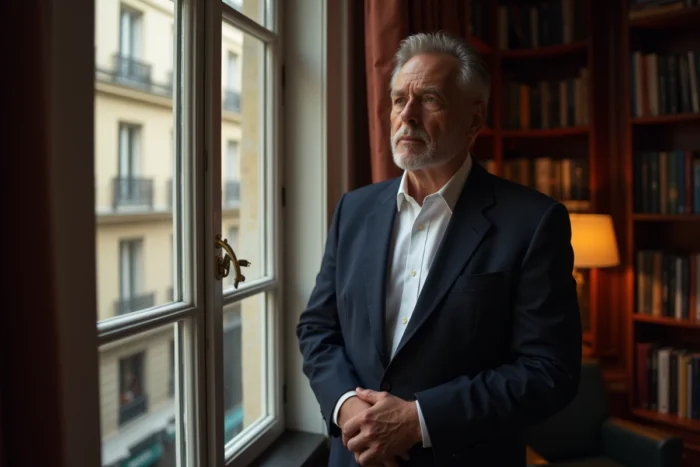
Alain Bauer has no children. This factual information, rarely stated so clearly in articles discussing his “family life,” radically changes the lens through which we view him. The criminologist, emeritus professor at CNAM, has established a clear separation between his constant media presence and a private sphere from which he reveals almost nothing.
Talking about “his children in the spotlight” thus amounts to examining a role of mentor and godfather, not a parenthood in the classical sense.
Twelve godchildren and a role as an intellectual godfather: Alain Bauer’s chosen family
A report from Lire Magazine and Ouest-France, conducted in Alain Bauer’s apartment, describes a space filled with books, with no presence of children. The journalist, however, mentions twelve godchildren, aged fifteen to thirty, who sometimes come to sleep over. This number outlines a family model based on mentorship rather than biological kinship.
This configuration explains why no photo of the “Bauer family” circulates, and why no child’s name has ever been mentioned in the press. Competing articles that refer to “his children” or “his family life” construct a speculative narrative around a documentary void. The real subject, which Alain Bauer’s children and his family allows us to explore, concerns how a public figure organizes a private entourage without direct parental ties.
Intellectual sponsorship, in the academic and Masonic circles that Alain Bauer frequents, has a structuring impact. It is not merely an emotional bond: the godfather transmits a network, professional codes, and access to closed circles. Twelve godchildren represent a considerable relational investment for someone whose public agenda is so busy.

Alain Bauer and child protection: public discourse versus private silence
On television sets, Alain Bauer regularly speaks about child protection. In Le Grand Rendez-Vous in 2026, he uses the phrase “protect our children” to describe the impotence of justice in the face of certain violence. On LCI, he comments on security developments with the same institutional analytical framework.
He never refers to personal parental experience. This consistency is remarkable over time. While other experts draw on their experiences as parents to lend credibility to their statements about youth or delinquency, Bauer maintains a strictly analytical stance. The register is that of the criminologist, not the father.
This dissociation serves a controlled communication strategy. By leaving no biographical foothold in the family realm, he prevents the media from constructing a personal narrative around his interventions. The phrase “families are not negligent, they have been laid off,” spoken on CNEWS, illustrates this mechanism: he talks about families as subjects of study, never as lived experience.
Right to image and voluntary discretion: the French legal framework applied to a borderline case
French law protects the private life of every person, including those in public positions. Respect for the right to image, governed by civil jurisprudence, requires prior consent for any identifiable photographic publication. For minors, this protection is reinforced by parental authority.
In Alain Bauer’s case, the question arises differently. Most of his godchildren are adults or close to adulthood. The legal framework that applies is therefore not that of strict minor protection, but that of common law regarding privacy. An adult godchild photographed alongside him at a public event does not benefit from the same protective regime as a minor child.
Bauer’s discretion does not rely on any particular legal arsenal. It is based on a personal choice, coupled with a lack of material exploitable by the tabloid press. No family ceremonies, no photographed vacations, no schooling to protect.
What the law allows and what practice prevents
- An adult godchild can freely appear in public with Alain Bauer without enhanced legal protection, unlike a minor child whose image requires the agreement of both parents.
- French law imposes no obligation of discretion on the relatives of a public figure: it is a voluntary choice, not a legal constraint.
- The media do not publish photos of Bauer’s private entourage, not due to prohibition, but due to a lack of available content: the best protection remains the absence of publishable material.

Alain Bauer’s private life: why mystery fuels speculation
The informational void surrounding Alain Bauer’s personal life produces a paradoxical effect. The less he communicates, the more searches about his family multiply. Queries like “Alain Bauer children,” “Alain Bauer wife,” “Alain Bauer private life” generate a volume of curiosity that the individual never satisfies.
This mechanism is classic for personalities who combine high media exposure with total lockdown of their intimate sphere. The public, accustomed to television figures sharing fragments of personal life, interprets silence as a secret to be uncovered rather than as a boundary set.
Bauer’s uniqueness lies in his area of expertise. A criminologist who advises institutions on security and who has held responsibilities in French Freemasonry carries with him an aura of professional confidentiality. This aura contaminates the perception of his private life: what is merely a choice of personal discretion is read as a deliberate concealment strategy.
Personal discretion or culture of professional secrecy
The line between the two is thin. Alain Bauer has presided over the Grand Orient of France, an institution whose internal functioning relies on the confidentiality of exchanges. This habit of compartmentalization naturally extends to the management of his personal image. The reflex is not that of a celebrity protecting their children from paparazzi, but that of a professional in intelligence and security who applies to his own life the principles he teaches.
The absence of biological children makes this strategy easier to maintain. A parent of a student encounters other parents, attends school events, leaves involuntary social traces. An intellectual godfather who receives his godchildren at home completely controls the perimeter of his private interactions. Bauer’s discretion is not a communication feat: it is the logical consequence of a family configuration that naturally produces few points of contact with the public space.