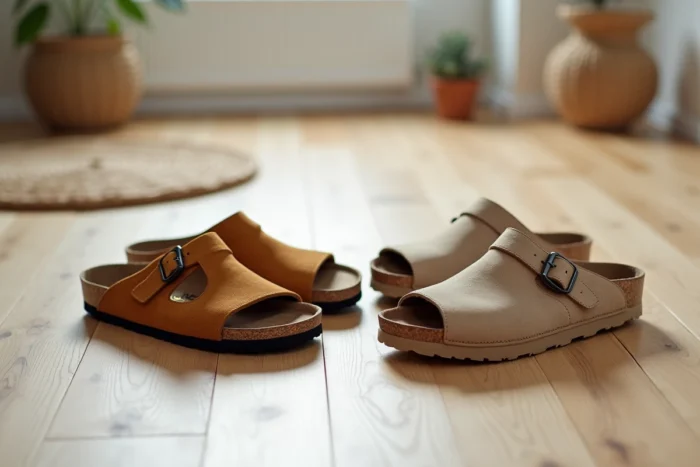
Scholl and Birkenstock occupy the same section in stores, but their insoles tell different stories. One promises relief from the very first minutes, while the other takes several days to reveal its potential. Comparing these two brands requires considering this timeline of comfort. Before choosing, it’s essential to understand what each insole does to the foot, and at what pace.
Scholl Insole vs. Birkenstock Insole: Two Logics of Foot Support
The fundamental difference lies beneath the foot. Scholl designs its insoles with a focus on immediate comfort and targeted support. The Pescura models, for example, incorporate soft cushioning that absorbs shocks from the very first step. The foot settles in without a period of adjustment.
Birkenstock, on the other hand, works in the opposite way. Its cork insole, which is stiffer, gradually conforms to the shape of the foot over the days. The anatomical adjustment builds over time, which often confuses new wearers. The first few days may feel firm, even uncomfortable, before the cork molds to the arch of the foot.
This temporal discrepancy explains much of the contradictory reviews online. A buyer who evaluates a Birkenstock after two days and another after three weeks are not describing the same shoe. For those comparing Scholl or Birkenstock shoes for comfort, this distinction between instant comfort and progressive comfort conditions the entire rest of the choice.

Flat Feet and Pathologies: Where Each Brand Reaches Its Limits
Birkenstock is often recommended for flat feet, but the effectiveness of its insole depends on the type of flat foot in question. A podiatrist from Michigan specializing in foot biomechanics distinguishes two very different scenarios.
For a flexible flat foot (the arch collapses under body weight but reforms at rest), the rigid Birkenstock insole can provide sufficient support. The cork limits the arch’s collapse and stabilizes walking.
In contrast, for a rigid flat foot or dysfunction of the posterior tibial tendon, the rigidity of the Birkenstock insole becomes insufficient. In these cases, neither Scholl nor Birkenstock replaces a custom orthotic paired with a more structured shoe. Field feedback varies on this point, as the boundary between flexible and rigid flat feet is not always clear without a clinical examination.
- Flexible flat foot without pain: Birkenstock offers adequate support for moderate daily use
- Rigid flat foot or tendon pathology: neither brand provides an appropriate solution without medical advice
- Diffuse plantar pain without diagnosis: Scholl can relieve more quickly thanks to immediate cushioning, but does not correct the cause
This distinction between flexible and rigid flat feet significantly alters the choice between the two brands for a substantial portion of buyers.
Materials and Durability: What Leather and Cork Imply in Daily Life
Birkenstock uses natural cork mixed with latex for its insoles and offers leather (smooth or suede) on most of its flagship models. Cork compresses and reforms slowly, which explains the longevity often cited by users. A regularly worn pair retains its supportive properties much longer than a classic synthetic insole.
Scholl diversifies its materials more according to its ranges. The Pescura models use wood and leather, while other models (mules, clogs, sneakers) use synthetics or technical foams. Durability varies significantly from one Scholl model to another, whereas Birkenstock maintains a more consistent material coherence across its entire catalog.
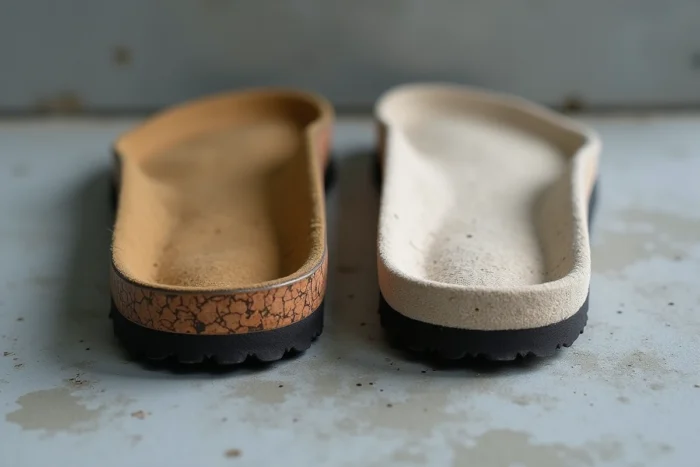
Birkenstock leather requires minimal but regular maintenance (moisturizing cream, air drying). Cork insoles are sensitive to prolonged immersion. On the Scholl side, wood-soled models like Pescura do not handle wet surfaces well, but synthetic versions are easier to clean.
Scholl or Birkenstock Sandals: For What Daily Use
The choice between the two brands becomes clearer when reasoning by usage situation rather than by brand.
For prolonged standing (health professions, hospitality, retail), Scholl offers cushioning that relieves from the first hour. The mules and clogs in the professional range are designed for this use. The foot does not tire during the adjustment phase, which matters when facing long days.
For outdoor walking over moderate distances, Birkenstock sandals (Arizona, Madrid, Gizeh) provide superior stability once the cork is broken in. The firmer insole limits micro-movements of the foot in the shoe, reducing friction over long distances.
- Professional standing use: Scholl has the advantage for comfort without break-in
- Urban walking or strolls: Birkenstock has the advantage after the adjustment period
- Mixed indoor/outdoor use: Scholl’s Pescura mules or Birkenstock’s Boston cover both contexts, with different compromises on rigidity
Style also plays a role. Birkenstock has shifted towards a fashion image since its collaborations with luxury houses. Scholl is still perceived as more functional, even though the brand has attempted to align with labels like Céline on certain Pescura models.
Price reflects these positioning strategies. Birkenstock is positioned in a higher range for most leather models, while Scholl offers a more accessible entry-level range, especially for synthetic references. The gap narrows on the high-end models of both brands.
Deciding between Scholl and Birkenstock comes down to whether one prioritizes comfort available from day one or support that improves over time. For a foot without specific pathologies, both brands deliver on their promises, but not on the same timeline. In the presence of pain or an identified deformity, a podiatric consultation can determine whether an off-the-shelf insole is sufficient or if a custom orthotic is necessary.