Immersive adventures have changed status. What was once a form of occasional entertainment is now part of a logic of cultural and narrative mediation in its own right, with formats designed to engage audiences from children as young as four to adults passionate about pop or heritage culture. We have observed a clear acceleration since 2024, driven by increasingly ambitious scenographies and game mechanics borrowed from escape rooms, virtual reality, and participatory theater.
Immersive scenography and spatial narration: what distinguishes a good adventure
A successful immersive experience relies on spatial narration: the decor tells as much of the story as the script. Recent productions like “Tutankhamun, the Pharaonic Immersive Experience” illustrate this principle with a large-scale reconstruction space designed for entire families to explore freely. Accessibility from the age of four imposes constraints on visual readability and pacing that designers integrate from the scenography phase.
The difference between a classic escape room and an immersive adventure lies in the narrative density of the location. In an escape room, the environment serves the puzzles. In an immersive adventure, the environment is the narrative. Every element of decor, every sound, every variation in light contributes to the dramatic progression. This allows mixed groups (children, teenagers, adults) to experience the same sequence with different levels of understanding.
We recommend prioritizing formats where the scenography occupies at least as much of the budget as the game mechanics. This is a reliable indicator of experience quality, found in players like our Legendary Adventures, who build their paths around complete narrative universes rather than a simple succession of puzzles.
Family escape room versus cultural immersive experience: two distinct logics
Confusing escape rooms with cultural immersive experiences is like comparing a sprint to a hike. The escape room imposes a timer (usually one hour), a single objective, and pressure to solve. The cultural immersive experience favors free exploration, contemplation, and gradual discovery.
For families with children under ten, this distinction has direct practical consequences:
- The classic escape room generates time stress that can frustrate younger participants if the puzzles are not segmented by difficulty level
- The so-called “Kids” rooms, with the presence of a facilitator in the room, partially solve this problem but reduce the group’s autonomy
- Cultural immersive paths (themed exhibitions, thematic mazes, outdoor adventures) allow each participant to progress at their own pace, which is better suited for intergenerational groups
The free format works better for groups where the age gap exceeds five years. Escape rooms remain relevant for closely aged siblings or homogeneous groups of friends.
Outdoor adventures and life-sized mazes: the rising offer
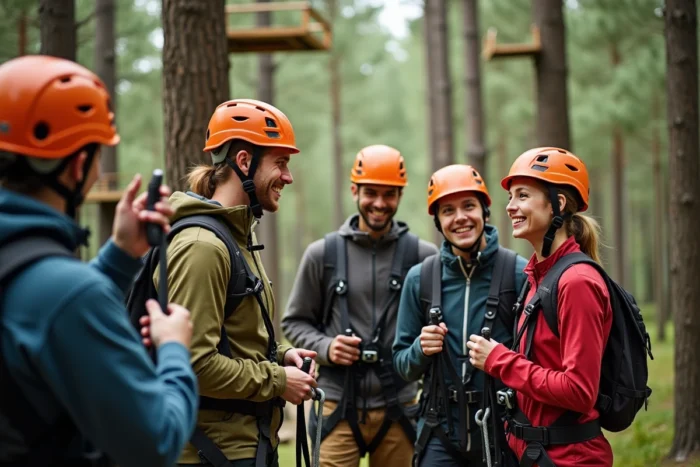
Immersive adventures are not limited to enclosed spaces. For the past two years, outdoor paths have gained ground, driven by a demand for less urban and more physical formats. In Belgium, the reopening of one of the largest mazes in the country with a new theme each season illustrates this trend. In France, structures like family adventure games in Aveyron combine hiking, geolocated puzzles, and historical narration.
The advantage of the outdoors for families lies in the natural modularity of the path. No strict capacity limits, no rigid time slots, and a welcoming capacity that allows large groups (family reunions, birthdays) to participate without fragmented reservations.
Designers of outdoor adventures now integrate technological layers (augmented reality on smartphones, narrative QR codes, scripted audio guides) that enrich exploration without imposing specific equipment. This is an effective compromise between immersion and accessibility.
Major cultural licenses and immersive exhibitions: the trend for 2024-2026
The massive arrival of major cultural licenses in the immersive field is transforming the market. The Little Prince, the LEGO universe with “Bricks of Wonder” (scheduled in Paris from May 2026), the Immersive City of Fables: these productions explicitly target a mixed family audience, children and adults who enjoy pop or literary culture.
This phenomenon goes beyond mere leisure. These exhibitions function as tools for cultural mediation, with educational content integrated into the scenography. A six-year-old traverses a spectacular decor while an adult discovers elements of art history or science integrated into the path.
For organizers of family outings, this convergence between culture and immersion opens a space that neither traditional museums nor amusement parks covered. The hybrid format between exhibition and interactive adventure constitutes the fastest-growing segment.
Concrete criteria for choosing a group immersive adventure
Before booking, we recommend checking a few parameters that do not always appear on booking pages:
- The actual minimum age (not just recommended): some virtual reality experiences require headsets that are not suitable for children under eight for ergonomic reasons
- The size of the group accepted per session: beyond six participants, the dynamics change and some rooms lose narrative intensity
- The presence or absence of a game master in real-time, which makes the difference between a guided experience and an autonomous experience
- The ratio between active phases (manipulation, movement, solving) and passive phases (projection, audio narration): a good balance maintains children’s attention throughout
The market for family immersive adventures has rapidly structured itself, with an offer that now covers both urban centers and rural areas. The quality of an experience does not depend on its location but on the coherence between its narrative universe, its game mechanics, and its adaptation to the audiences it claims to host. It is on these three axes that the difference between a good memory and an outing forgotten by the return trip is played out.