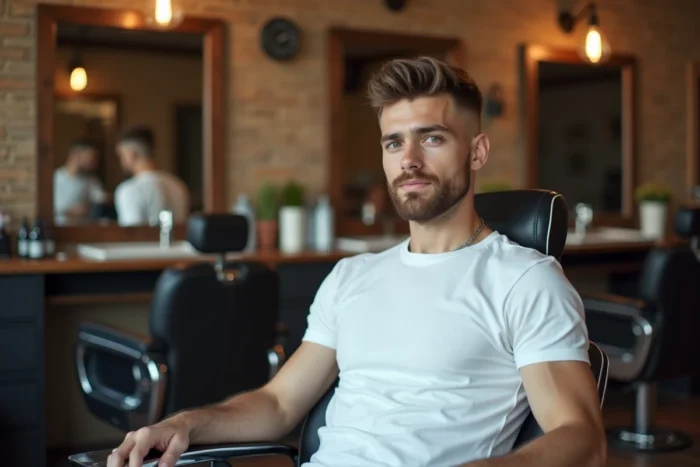
Between the low taper that lightly grazes the skin and the marked fade that creates a sharp contrast, the low men’s fade relies on precise technical markers. The low fade haircut for men is distinguished by a transition area concentrated just below the top of the ear, making it more subtle than its mid or high variants. Understanding where the differences lie helps to formulate the right request at the salon and anticipate maintenance frequency.
Low taper or low fade: technical markers for choosing
The two terms often circulate as synonyms, while they describe distinct results. The low taper gradually reduces length without ever exposing the skin, while the low fade goes down to the skin on the last millimeters of the nape and temples. The choice between the two alters the visual balance of the face and the speed of visible regrowth.
| Criterion | Low Taper | Low Fade |
|---|---|---|
| Fade Area | From the length on top to a short length, with no visible skin | Transition down to the skin on the nape and temples |
| Contrast | Subtle, natural | More pronounced, sharp line |
| Maintenance (touch-up) | Every 4 to 6 weeks | Every 2 to 3 weeks |
| Effect on the Face | Softens features, slightly elongates | Structures contours, narrows temples |
| Ideal for | Professional context, discreet look | Bold style, paired with sculpted beard |
The tipping point between low fade and mid fade is around 2 cm above the top of the ear. Beyond this marker, the temples appear more exposed and the contrast intensifies. Keeping this threshold in mind helps to make a precise request to the barber.
A detailed guide on the low fade haircut for men allows visualization of these technical differences before making an appointment.

Low fade and face morphology: a correction tool
The low fade is not just an aesthetic choice. It acts as a proportion corrector, which explains its growing popularity in specialized salons.
A round face gains structure with a low fade that narrows the temples and creates verticality on the sides. Conversely, an elongated face benefits from a low taper that retains some lateral volume and avoids emphasizing length.
- Square face: the low taper softens angles by maintaining a smooth transition around the ears, without a sharp demarcation line
- Oval face: both options work, but the low fade highlights the jawline more by clearly exposing the nape
- Triangular face (wide forehead, narrow chin): a low fade paired with volume on top rebalances proportions by drawing the eye upward
The low fade corrects proportions without altering the length on top. This is what makes it so versatile: it adapts well to a textured crop as well as a longer style styled back.
Hairstyle styles compatible with the low men’s fade
The low fade serves as a base for several cuts. Three associations stand out for their balance between ease of maintenance and visual result.
French crop with low fade
The short, textured fringe of the French crop pairs well with a low fade. The contrast between the fringe and the exposed temples creates a structured effect that works on straight as well as slightly wavy hair. Styling is reduced to a texturizing product applied to damp hair.
Buzz cut and low taper
The buzz cut combined with a low taper creates a minimalist look that requires almost no daily maintenance. The subtle fade on the sides avoids the uniform appearance of a classic clipper cut. This is the easiest combination to maintain between two visits to the barber.
Curly hair and low fade
On curly or frizzy hair, the low fade reshapes the face contour while allowing the natural volume to express itself on top. The effect produces a clean framing that highlights the texture of the curls. Touch-ups can be spaced out (every four to six weeks) since regrowth blends better into curls than on straight hair.

Low fade maintenance: frequency and products
The lifespan of a low fade directly depends on the type of fade chosen. A low taper retains its shape longer than a skin fade, where even the slightest regrowth disrupts the sharp line.
A low fade requires a touch-up every two to three weeks, compared to four to six weeks for a taper. This difference in frequency represents a concrete selection criterion, especially if the haircut budget is a factor.
In terms of products, the low fade itself requires nothing special on the faded areas. The focus is on the top:
- Matte paste or clay for short textured cuts (French crop, messy crop) to separate strands without a shiny effect
- Light styling cream for curly hair, which defines curls without weighing down the volume
- Sea salt spray for a natural effect on medium-length hair, enhancing texture without freezing the cut
A often overlooked point: the nape. On a low fade, the nape line should remain sharp between appointments. A quick pass with clippers without a guard on the lower contour is enough to extend the neat appearance for a few days.
The low fade remains the most adaptable variant of the men’s fade. Its discreet positioning below the ear allows it to function in strict professional contexts as well as in bolder styles. The decisive factor is not so much the style on top as the type of fade chosen on the sides, as it dictates maintenance frequency and the final contrast.