
A cat that gives birth to three kittens and then stops for several hours before expelling two more is a situation that many owners find themselves unprepared for. One expects a continuous process, only to face an animal that seems to have finished while there are still more kittens to be born. Understanding this phenomenon helps avoid unnecessary panic or, conversely, to identify a real emergency.
Interruption of labor in the cat: an unknown physiological mechanism
In cats, labor can be fragmented into two distinct phases separated by a prolonged pause. This is sometimes referred to as interrupted labor. The mother expels part of the litter and then enters a phase of complete rest that can last several hours. During this pause, she eats, nurses the already born kittens, and appears perfectly comfortable.
This behavior clearly distinguishes the cat from the dog, where prolonged interruption of labor is more often pathological. In cats, this pause can last up to an entire day without the mother showing any signs of distress. This phenomenon is more frequently observed in large litters when the uterus contains kittens distributed in its two horns.
The multi-stage birth in cats remains poorly documented in popular literature, which explains why so many owners call their veterinarian in an emergency during a pause that is actually part of normal functioning.
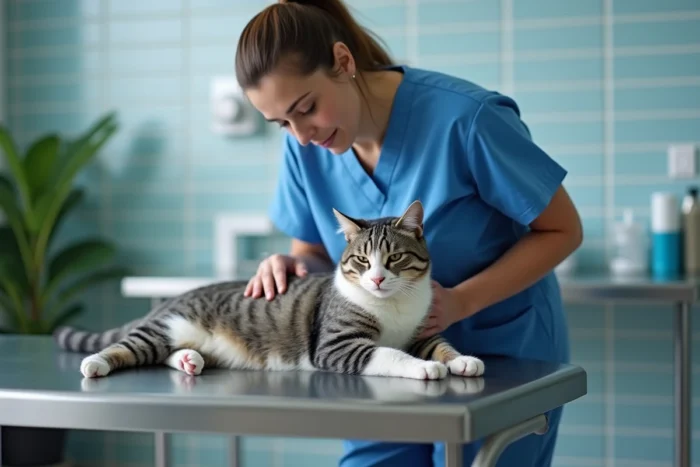
Warning signs versus normal pause during cat labor
The concrete difficulty on the ground is distinguishing a physiological pause from dystocia. We observe the cat, and the question always arises: should we intervene or wait?
Here are the criteria that indicate a normal situation:
- The cat is calm, actively caring for her already born kittens, licking and nursing them without agitation
- No abnormal vulvar discharge (no persistent greenish fluid or excessive blood)
- No visible contractions without expulsion for more than two hours
- The mother is willing to eat or drink during the pause
On the other hand, certain signals warrant an immediate call to the veterinarian. Strong and repeated abdominal contractions without results for more than two hours indicate a kitten possibly stuck in the pelvic canal. A greenish discharge that appears without being followed by a birth within two hours indicates that the placenta has detached, putting the kitten in danger.
The common mistake: confusing rest and exhaustion
A cat in a physiological pause remains toned and responsive. She changes position and moves around her nest. A cat in distress remains prostrate and no longer cares for her kittens. This behavioral distinction is the first reliable indicator before any palpation or examination.
Reports vary on the maximum acceptable duration of a pause. Some veterinarians recommend a consultation if labor does not resume within four to six hours, while others tolerate a longer delay as long as the mother remains in good general condition.
Expulsion of placentas and post-birth monitoring
Each kitten is born wrapped in its fetal membranes, accompanied by its placenta. There should be as many placentas as there are kittens expelled. A retained placenta (not expelled) poses a serious infection risk for the mother, potentially leading to metritis in the days following birth.
When labor occurs in multiple stages, this counting becomes more complex. The cat often ingests the placentas, which is a normal behavior but complicates verification. In this case, vigilance regarding the mother’s condition in the following days replaces direct counting.
What to monitor in the hours after the last kitten
- A pink to brownish vulvar discharge is normal for several days; a foul-smelling or purulent discharge is not
- A fever within 48 hours postpartum warrants a consultation
- The mother who refuses to eat more than 24 hours after the complete end of labor should be examined
Gentle abdominal palpation can sometimes detect if a kitten remains, but this manipulation requires experience. In case of doubt, an ultrasound or X-ray at the veterinarian provides a definitive answer.
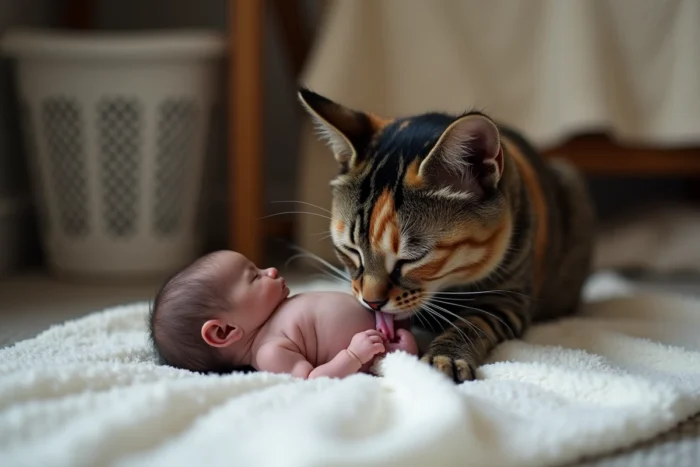
Gestation and repeated litters: an underestimated health risk
One aspect rarely addressed in birthing guides concerns the cat’s ability to become pregnant very quickly after giving birth. An unspayed cat can go into heat just a few weeks after the birth of her kittens, exposing her to closely spaced pregnancies with a direct impact on her health.
Feline protection associations report an increase in cases of stray or semi-feral cats giving birth at private homes, in gardens, basements, or on balconies. These births in unsuitable locations (exposure to the elements, presence of predators) affect the survival of the kittens and the recovery of the mother.
Spaying remains the only reliable method to prevent these repeated pregnancies. It can be performed after the kittens are weaned, in agreement with the veterinarian. For a cat that has given birth in multiple stages with a large litter, this discussion should be initiated as early as the postpartum visit.
Fragmented birth in cats remains a process that, in the majority of cases, does not require human intervention. The best approach is to remain a careful observer, count the kittens and placentas, and know the signals that distinguish a normal pause from a real complication.