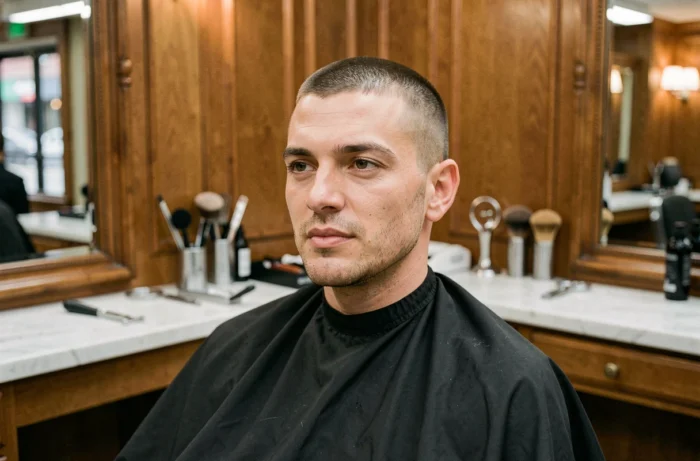
The buzz cut comes down to a clipper, a guard, and a few millimeters of hair. The choice of length is not trivial. Between a #1 guard that leaves the scalp almost visible and a #4 guard that retains a perceptible texture, the visual difference is considerable. The shape of the skull, the morphology of the face, and even the state of the hairline radically change the appearance of the same cutting height.
Guard, clipper, and millimeters: what each number changes on the skull
The guard numbers correspond to specific length ranges. A #1 guard cuts to about 3 mm, a #2 to 6 mm, a #3 to 9-10 mm, and a #4 to 12-13 mm. Beyond that, one gradually moves out of buzz cut territory into crew cut or other structured short hairstyles.
The difference between a #1 and a #2 seems minimal on paper. On the skull, it alters the perception of the scalp. With a #1 guard, the skin remains visible under the hair, exposing every irregularity: scars, spots, asymmetries of the skull. A #2 offers just enough coverage to soften these details without adding volume.
Determining the ideal length for a buzz cut largely depends on what the skull reveals once shaved. Trying a #3 guard allows for testing the look without committing to a too radical length.

Face shape and buzz cut length: successful combinations
Most guides simply state that the buzz cut suits everyone. Recent feedback from barbers and specialized sources tells a more nuanced story, where the shape of the face dictates the guard height.
Oval face
This is the most permissive morphology. From guard #0 to #4, almost all lengths produce a balanced result. The choice is more about the desired style (raw minimalist or visible texture) than about a proportional constraint.
Round face
Shaving evenly to a very short length accentuates the roundness of the skull and face. The “billiard ball” effect sets in. To visually elongate the proportions, several barbers recommend keeping the top longer (guard #3) with shorter sides (#1 or #2). This slight contrast creates an illusion of verticality without leaving the buzz cut realm.
Long or rectangular face
The trap is the opposite. A very short top (#1) further elongates the face by reducing volume at the top of the skull. Sticking to a #3 or #4 guard, or even opting for an even distribution, compensates for this disproportion. The sides should not be shaved too short either, risking hollowing out the temples and accentuating the rectangular effect.
Buzz cut and receding hairline: what length limits the damage
The buzz cut is often presented as the ideal solution for men with a receding hairline. This is partially true, but the chosen length plays a crucial role in the outcome.
With a #3 or #4 guard, the difference in density between the receding forehead and the rest of the skull remains noticeable. The sparse areas contrast with the still thick areas. A #1 or #2 guard reduces this density contrast by visually bringing all areas of the skull to a similar level of coverage.
On the other hand, going down to a #0 guard (less than 1.5 mm) fully exposes the scalp and can make baldness more visible than with a #1, depending on skin color and hair pigmentation. Men with fair skin and dark hair are most affected by this phenomenon: the skin/hair contrast persists even at minimal length.
- Slightly receding forehead: guard #2, which evens out the density without fully exposing the scalp.
- More advanced baldness (vertex and temples): guard #1, to minimize the gap between thick and sparse areas.
- Diffuse baldness across the entire skull: guard #0 or complete shaving, provided one accepts the regular maintenance this entails.
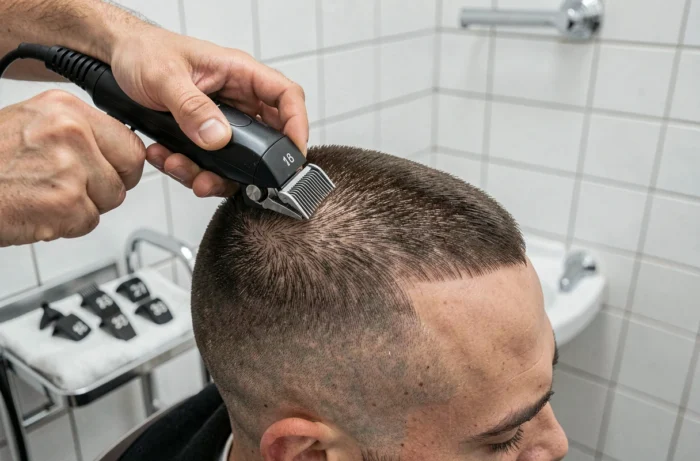
Maintenance according to length: clipping frequency and scalp care
The shorter the buzz cut, the quicker the regrowth becomes noticeable. A #1 guard loses its neat appearance in less than a week, while a #3 or #4 guard easily tolerates ten to fifteen days before looking unkempt. The frequency of clipping affects the result as much as a good choice of guard.
The scalp, exposed to the sun and friction, requires different attention than a skull covered by several centimeters of hair. A moisturizing spray or a product suitable for the scalp limits post-clipping irritations, especially with the lowest guards.
- Guard #0 to #1: clipping every four to six days to maintain a uniform appearance. Sunscreen necessary on the scalp in summer.
- Guard #2: weekly clipping. The scalp remains partially covered, but the clipper lines (ears, nape) blur quickly.
- Guard #3 to #4: clipping every ten to fifteen days. Styling products remain unnecessary; a gentle shampoo is sufficient for daily maintenance.
Uniform buzz cut or faded on the sides: the impact on perceived length
A uniform #3 buzz cut all over the head does not produce the same effect as a #3 on top with a gradual fade to a #1 on the sides. The fade alters the perception of length without touching the top of the skull.
A high fade concentrates volume on the top and narrows the sides, which suits round faces. A low fade retains more material on the temples and softens the contours, suitable for angular faces. The choice of fade influences the result as much as the guard number.
This distinction is rarely mastered in home clipping. The fade requires a millimeter transition between several guards, often done with a clipper without a guard and a rear mirror. The contours around the ears and nape are the most delicate area, where symmetry errors are immediately noticeable.
Choosing a buzz cut length thus relies on a set of variables, not on a universal guard number. The morphology of the face, the state of the hairline, and the desired type of fade are three parameters to consider before setting the clipper guard. Testing a #3 guard all over the skull remains the safest starting point to evaluate the look before adjusting.