
We open a bag of chips for an aperitif, glance vaguely at the label, and put the bag back without understanding anything. Salt, saturated fats, Nutri-Score, additives: the criteria pile up, but their hierarchy remains unclear for most consumers. Choosing less harmful chips without ending up with a product that tastes like cardboard requires knowing how to read three or four indicators, no more, and understanding what they really measure.
Salt and saturated fats: the two numbers to check first on the bag
Before the Nutri-Score, before the list of additives, we look at two lines of the nutritional table. Salt and saturated fats are the most discriminating markers between two bags of chips placed side by side on the same shelf.
Salt varies greatly from one brand to another. Some classic potato chips contain about 1.2 g of salt per 100 g, while so-called “vegetable” chips or those made from legumes can exceed that significantly. Tests by the Swiss FRC and comparisons by 60 Millions de consommateurs confirm that health marketing does not guarantee lower salt.
For saturated fats, the cooking method makes all the difference. Oven-baked chips generally have a lower saturated fat content than chips fried in palm or sunflower oil. Therefore, we look for a bag that combines moderate salt and oven baking, or, if not, an oil with a more favorable lipid profile (olive, rapeseed).
A detailed comparison allows us to identify the healthiest chips by cross-referencing these two criteria with the Nutri-Score and the presence of additives.
Legume chips and protein: what the Nutri-Score doesn’t tell you
Chips made from lentils, chickpeas, or split peas are taking up more and more shelf space. Their main selling point can be summed up in two words: protein and fiber. On this point, Belgian tests by Test-Achats and German analyses by Shop-Apotheke converge. Legume chips are more filling than classic potato chips, which can limit the amount consumed in one sitting.
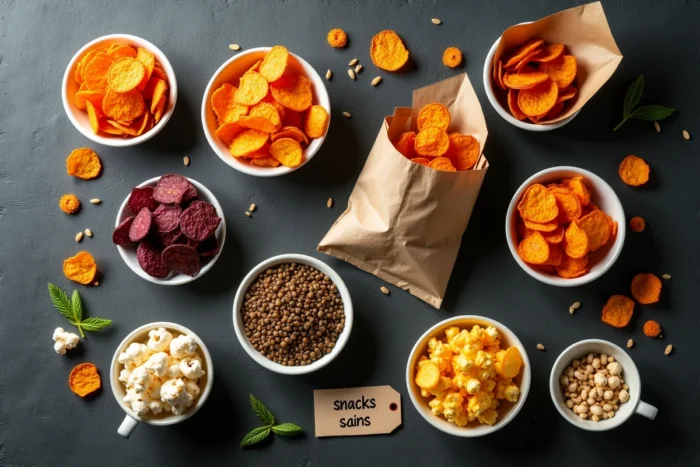
The Nutri-Score of these products ranges from B to D depending on the brands. A B does not mean “good for health”; it means “less unfavorable than the average of the category.” We have seen legume chips with a decent Nutri-Score while containing a longer list of additives than a plain potato chip.
What to check concretely on the bag:
- The protein and fiber content per 100 g, which should be significantly higher than that of a classic chip to justify the extra cost
- The position of the oil in the ingredient list (the higher it appears, the more the product contains)
- The number of flavors and additives, often higher in “alternative” chips than in a basic plain chip
A bag of lentil chips packed with flavors is not necessarily better than a plain potato chip fried in olive oil with three ingredients. The length of the list matters as much as the plant-based content.
Acrylamide and cooking: the criterion missing from most comparisons
Acrylamide is a substance that forms during the high-temperature cooking of starchy foods. Chips, by definition, tick all the boxes. This criterion is rarely mentioned on packaging and is absent from most consumer comparisons, even though it is subject to European regulatory monitoring.
You cannot measure acrylamide by reading the label. However, two clues help limit exposure:
- The color of the chips: the darker or more browned they are, the higher the acrylamide content tends to be
- The cooking method: oven-baked or puffed chips generally generate less acrylamide than chips fried at very high temperatures
- Legume chips are not spared, as the cooking process remains similar
Choosing light-colored, oven-baked chips reduces exposure to acrylamide without needing a laboratory. It’s a simple visual reflex to adopt in the snack aisle.
Vegetable chips: a common trap
Beetroot, sweet potato, or parsnip chips attract with their natural image. In practice, they undergo the same frying process as potato chips. Their salt and saturated fat content is often comparable, sometimes higher.
The actual nutritional gain (a few vitamins, a bit more fiber depending on the vegetable) is marginal compared to the portion consumed. You don’t eat 100 g of beetroot chips to meet your folate needs. Vegetable chips are still chips, not vegetables.
Frequency of consumption: the factor that the label never mentions
Even a well-rated chip on Yuka, showing a Nutri-Score B and a short ingredient list, remains an ultra-processed food, very high in calories and low in micronutrients. Feedback on this point varies among nutritionists consulted in the media, but one constant remains: frequency matters as much as the composition of the bag.
Reserving chips for occasional aperitifs rather than weekly snacking has a greater impact on health than the choice between two brands. One bag a month of an “average” chip weighs less than one bag a week of a “healthy” chip.

The taste, in all this, is determined by simple parameters. A plain chip with few ingredients (potato, olive oil, salt) offers a crunch and a straightforward flavor that lighter or reformulated versions often struggle to match. Searching for the perfect chip nutritionally while accepting a bland taste leads to eating more to compensate for frustration, which negates the benefit.
The best compromise remains a product with a short ingredient list, oven-baked or fried in quality oil, consumed occasionally. Three criteria on the label (salt, saturated fats, number of ingredients), a glance at the color, and controlled frequency: we don’t need more to snack without deceiving ourselves.