
When launching an online multiplayer game in 2026, the first thing that changes compared to two years ago is not the graphics or network fluidity. It’s the consent screen. Age verification before accessing voice chat, enhanced PEGI ratings on popular free-to-play titles, restrictions on random purchases: online gaming is restructuring around new regulatory constraints that alter the experience right from the home screen.
PEGI Rating and Loot Boxes: What Changes for Online Games
Since June 2026, any new game submitted to PEGI containing paid random items (loot boxes, gacha, card packs) receives at least a PEGI 16 rating. Depending on how these mechanics are integrated, the rating can go up to PEGI 18.
In practice, we are already seeing the effects on the ground. Major publishers, including EA, are explicitly mentioned, revising their purchase mechanics to avoid a rating increase. For a multiplayer game targeting a broad audience, moving from PEGI 12 to PEGI 16 means losing an entire segment of potential players, and especially complicating distribution on certain platforms.
This tightening transforms the very design of free-to-play games. Studios that heavily monetized through random systems must find alternatives: fixed-content battle passes, transparent cosmetic shops, or subscription models. To keep up with these developments and daily news in online gaming, one can rely on specialized portals like onlygames.fr that centralize reviews and trends.
The question remains open for games already in circulation. The new PEGI framework applies to recent submissions, but feedback varies on the retroactive application to existing titles that integrate loot boxes through updates.

Age Verification and Voice Chat: Social Features Under Control
In the UK and Ireland, age verification became mandatory in 2026 to access the social features of online games. This includes voice chat, messaging, groups, and streaming integrated into gaming platforms.
For us gamers, this translates to an additional step during account creation or the first login to a multiplayer server. Depending on the publishers, the method varies: age estimation through facial recognition, verification by ID, or control via an already authenticated parental account.
A similar pilot is underway at the European Union level. If this approach becomes widespread, we can expect massively multiplayer games to add progressive access barriers:
- Access to solo play as soon as the standard rating is achieved, without enhanced verification
- Age verification required to unlock voice chat and real-time messaging
- Mandatory parental control for accounts identified as minors, with restrictions on in-game transactions
This segmentation of social features reshapes the very architecture of online games. Studios must plan for “degraded” versions of the multiplayer experience for unverified players, which represents a significant development cost.
Esports and Online Streaming: A Market Structuring Differently
The global esports and streaming market is expected to reach $5.24 billion by 2031, driven by 5G, media rights, and the proliferation of viewing platforms. What interests us here is the direct impact on how we consume online gaming.
5G does not only change latency in games. It enables high-quality streaming of competitions on mobile, without Wi-Fi infrastructure. For online tournaments, this means a potential audience watching from anywhere, not just behind a PC or fiber box.
Media rights, long neglected in esports, are becoming a revenue lever comparable to what we see in traditional sports. Leagues are signing exclusive broadcasting agreements with streaming platforms, which fragments access for viewers but stabilizes revenue for teams.
What This Means for Competitive Players
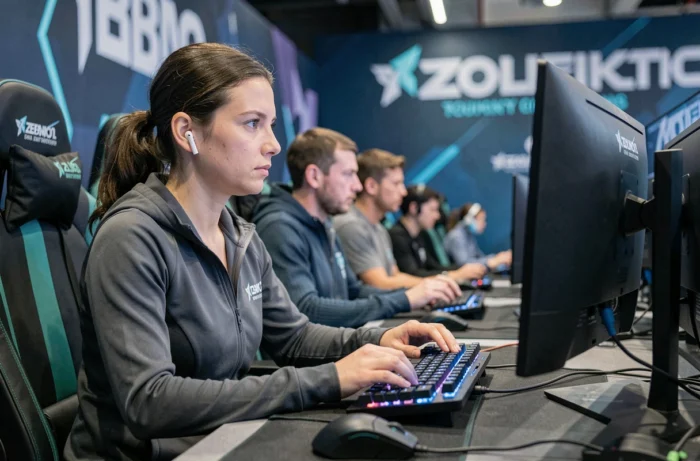
The professionalization of the circuit no longer concerns just top players. We are seeing the emergence of semi-professional structures that recruit on ranked servers, with regulated contracts and income from streaming rather than just tournament winnings. The competitive path now goes through Twitch as much as through the ladder.
Mobile Games and the European Market: Numbers That Influence Publishers’ Choices
The European mobile gaming market continues to grow at a steady pace. This progression directly influences publishers’ decisions regarding priority platforms for their new online titles.
Specifically, several franchises that were exclusively PC or console are now launching mobile versions simultaneously, or even ahead of time. This is no longer a late port: mobile is integrated from the design phase, with native touch interfaces and progression systems adapted for short sessions.
For PC and console players, this trend has direct consequences on game design:
- Interfaces are simplified to remain readable on small screens, which may impoverish menus on large screens
- Gameplay loops are shortened to adapt to mobile sessions of a few minutes
- Monetization systems align with mobile standards (battle pass, cosmetics, energy), even in PC versions
- Cross-play between mobile and PC/console raises competitive balance questions that studios struggle to resolve
Europe represents a significant share of this mobile market, which explains why publishers are adapting their release schedules and monetization strategies to European regulations, with PEGI at the forefront.
Online gaming in 2026 is defined less by its new titles than by the framework in which it is played. Between PEGI constraints on random purchases, age verification for social features, and the rise of mobile as the reference platform, it is the environment around the game that is changing the fastest. Studios that anticipate these changes keep their communities intact, while others lose players even before the first patch.