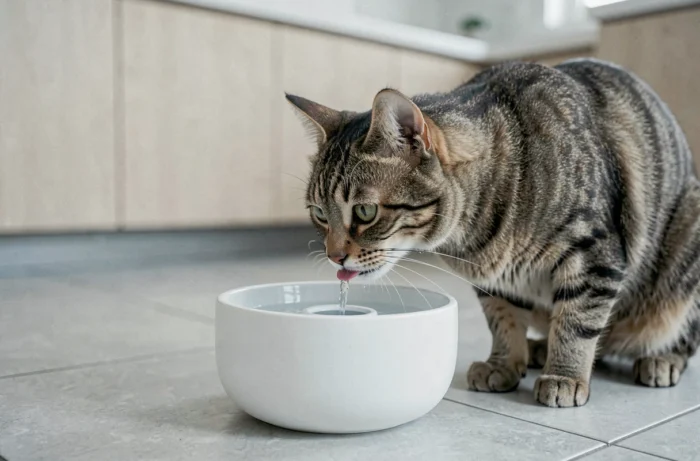
A cat drinking from a standard bowl filled with tap water in a hard water area often ends up abandoning its water source. The whitish deposit that forms at the bottom, the smell of chlorine, the stagnation: all these signals reduce its consumption. The problem is not limited to comfort. Insufficient hydration puts a strain on the kidneys and promotes the formation of urinary crystals, especially in cats fed dry food.
Choosing a water fountain suitable for the hardness of the local water and the profile of your cat makes a long-term difference. This is not just a gadget, but a choice that affects the renal and urinary health of the animal.
Local water hardness: the parameter that no one checks before buying
Before comparing models, one should start by measuring the TH (hydrographic title) of the tap water. This figure, expressed in French degrees, indicates the concentration of calcium and magnesium. Water is considered hard beyond a certain threshold, and it is precisely in these areas that limescale degrades the functioning of a standard fountain within a few weeks.
Limescale does not just leave white marks. It clogs the pump, reduces the flow, and makes the fountain noisy. A cat sensitive to noise or wary will simply stop approaching it. We then lose the main interest of the device: to encourage hydration through the movement of water.
Knowing your TH allows you to choose the right filtration system. In a soft water area, an activated carbon filter is sufficient to remove chlorine and impurities. In a hard water area, one should opt for a cat water fountain that is anti-limescale equipped with an ion exchange resin, which captures some of the calcium and magnesium before the water reaches the bowl.
Ion exchange resin, activated carbon, UVC: what each technology filters
Not all filters do the same job. Confusing impurity filters with anti-limescale filters is the most common mistake. Here’s what each technology actually targets:
- Activated carbon: absorbs chlorine, certain odors, and some dissolved organic compounds. Improves the taste of water but does not act on limescale.
- Ion exchange resin: retains calcium and magnesium to soften the water. This is the component that distinguishes an anti-limescale filter from a standard filter. Catit incorporates this resin into its triple-action filters, combined with activated carbon and a filtration cotton.
- UVC sterilization: destroys bacteria and microorganisms through ultraviolet radiation. Does not change hardness or taste. Useful for limiting the formation of biofilm, this slimy film that appears on surfaces when cleaning is infrequent.
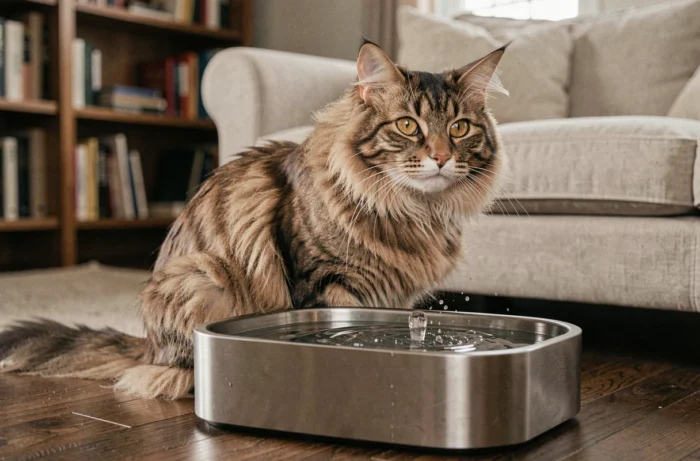
A model like the Catit Pixi in stainless steel combines UVC and filtration. However, UVC sterilization does not replace regular manual cleaning of the fountain and water circuit.
Frequency of filter replacement
Feedback varies on this point depending on water hardness. In a very hard water area, the resin saturates faster and the filter loses its effectiveness before the duration stated by the manufacturer. It is recommended to monitor the appearance of white deposits on the pump or in the bowl as a concrete indicator of saturation, rather than relying solely on the calendar.
Fountain material: ceramic, stainless steel, or plastic depending on the cat’s profile
The material is not just an aesthetic question. It directly affects hygiene, durability, and acceptance by the animal.
Plastic remains the cheapest material, but also the most porous. Over time, micro-scratches appear and become breeding grounds for bacteria. Some low-quality plastics contain BPA. For a cat prone to feline acne (those little black spots on the chin), switching to stainless steel or ceramic often reduces the problem.
Stainless steel is easy to clean, resistant to limescale, and dishwasher-safe for most models. Ceramic offers greater weight (the fountain moves less) and a smooth surface that limits bacterial adherence. It is particularly suitable for cats that tip over their bowl.
The choice also depends on the number of cats in the household. With multiple animals, the water becomes contaminated faster. A non-porous material combined with an anti-limescale filter extends the interval between two complete cleanings, without compromising water quality.
Maintenance of an anti-limescale fountain: frequency and concrete actions
A fountain, even equipped with the best filter, does not operate in automatic mode. Biofilm, this slimy layer that forms on surfaces in contact with water, appears within a few days if the ambient temperature is high. UVC sterilization slows its formation but does not completely prevent it.
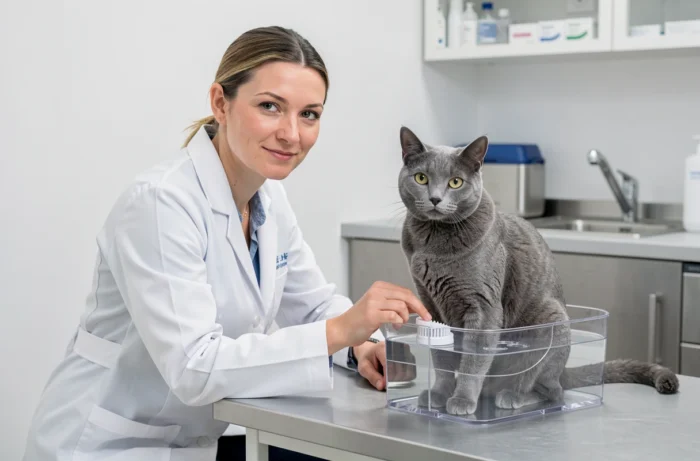
Cleaning the pump is the most often neglected action. When the flow weakens, one thinks of changing the filter when the problem comes from a clogging of the rotor. A quick rinse under water with a small brush (like a toothbrush) is enough to restore normal operation.
- Rinse the bowl and removable parts every three to five days, more often in summer or in a multi-cat household
- Replace the filter based on the actual state of limescale deposits, not just according to the manufacturer’s schedule
- Dismantle and clean the pump at least once a week to prevent tartar buildup on the rotor
- Ensure that the power cable remains dry and away from any source of moisture on the ground
Regular maintenance of the pump extends its lifespan and maintains an attractive flow for the cat. A flow that is too weak loses the effect of running water that stimulates consumption.
Anti-limescale fountain and cat renal health: the concrete link
Cats primarily fed dry food derive almost all of their water intake from their water source. A fountain that maintains a regular flow, fresh water, and no chlorine taste naturally increases drinking intake. Sufficient hydration dilutes urine and limits the concentration of minerals responsible for the formation of crystals.
Cats predisposed to urinary disorders (certain breeds, neutered cats, sedentary cats) benefit more from softened water. Reducing the calcium load in drinking water, even partially, contributes to this goal. It is not a treatment, but a complementary preventive lever to appropriate diet and veterinary follow-up.
The real criterion for choice is therefore not “fountain or bowl,” but the combination of water hardness, material, type of filtration, and regularity of maintenance. An anti-limescale stainless steel model with a resin filter, cleaned weekly, covers most situations. For a healthy cat in a soft water area, an activated carbon filter in a ceramic fountain does the job perfectly.