Outdoor family leisure activities are no longer limited to a Sunday stroll in the nearest park. The trend towards micro-adventure formats, which are shorter and less logistically demanding, changes the game for parents who want to go out with children without turning every outing into an expedition. We are also seeing a shift from purely sports activities to practices of observation and creativity outdoors, which significantly broadens the profile of the families involved.
Responsibility of outdoor activity organizers: what has changed
One point that family leisure guides systematically overlook concerns legal responsibility. The Court of Cassation has expanded the obligations of professional organizers of sports and leisure activities: security instructions must be adapted to the relevant audience, especially when children are involved. Otherwise, the organizer can no longer easily invoke the victim’s negligence to share responsibility in the event of bodily harm.
In practical terms, this means that when you enroll your children in a supervised activity (tree climbing, canoeing, climbing), the provider is required to provide specific instructions and not just a generic briefing identical to that of adults. Check that the provider clearly distinguishes levels and adapts their equipment.
For parents, this is also a selection criterion. We recommend prioritizing structures that display a safety protocol differentiated by age group, rather than those that settle for a standard waiver form. You will find activities referenced and filtered by audience on the myfishbook.fr leisure site, which facilitates this sorting in advance.
Family micro-adventure: the format that replaces the classic outing
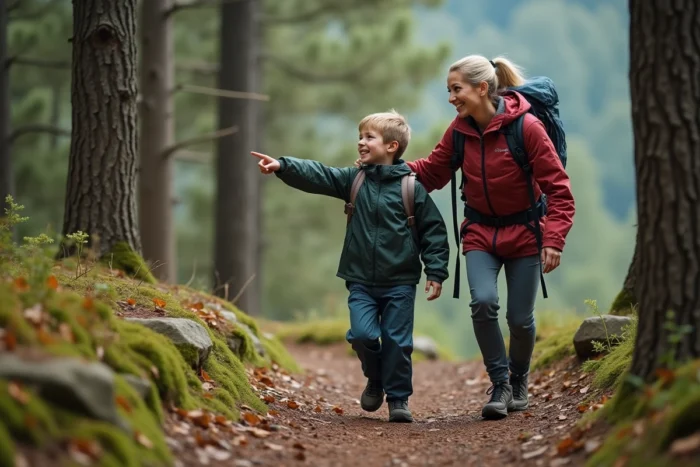
The concept of family micro-adventure is gaining ground. The principle: nature getaways lasting a few hours to a day, accessible from home, without heavy booking or several hours of driving.
This format addresses a constraint that parents know well. Organizing an outdoor outing with young children requires a preparation/pleasure time ratio that is often unfavorable. The micro-adventure reverses this logic by reducing logistics to the strict minimum.
What distinguishes a micro-adventure from a simple walk
- A concrete objective given to the children before departure (finding three species of birds, identifying a tree by its leaves, following a route on a paper map) turns the outing into an exploration game
- A limited geographical perimeter, often within a biking or public transport distance, which eliminates travel fatigue
- A duration calibrated to the attention span of the youngest, generally between two and four hours, with the possibility of shortening without frustration
- An element of surprise or novelty (bivouac in the garden, picnic by a stream, nighttime insect observation) that marks the memory
The idea is not to spend more but to go out differently. Regional parks, suburban woods, and towpaths offer a playground largely underutilized by families who consider them too ordinary.
Family outdoor activities focused on observation and creativity
Reducing outdoor leisure to physical exertion excludes some children and parents. Observation activities (simplified ornithology, land art, naturalistic drawing) and creative outdoor games provide a serious alternative to sports courses.
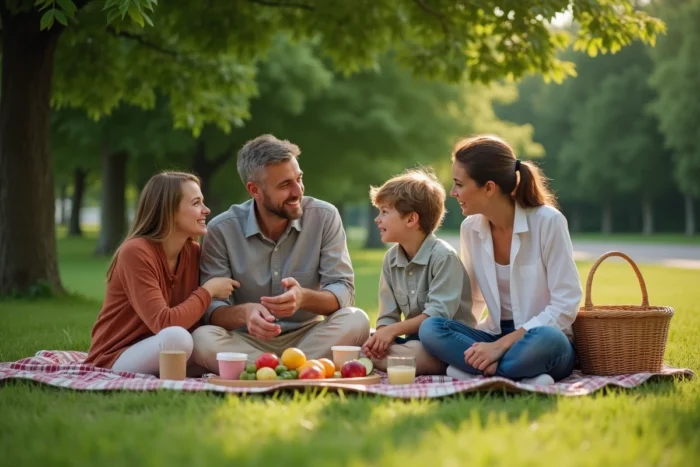
Land art, for example, requires no equipment. Children collect natural elements (stones, leaves, branches) to create ephemeral compositions. This practice develops attention to the natural environment without requiring any particular sporting skill.
Classic outdoor games to rediscover
Traditional outdoor games (simplified orienteering, nature treasure hunts, building wooden huts) are making a comeback in family practices. Their advantage: they require neither registration nor expensive equipment, and they work with mixed age groups.
We observe that families alternating between physical outings and creative outings maintain a more regular practice rhythm throughout the year. Regularity matters more than intensity to anchor outdoor activities in family habits.

Public spaces and children: an evolving framework
The debate on the place of children in French public space has taken on an institutional dimension. The CNCDH issued an opinion stating that the issue is not limited to banning “no kids” spaces: public space needs to be rethought to integrate children more, particularly through school streets and calm traffic.
This direction has practical consequences for family outings in urban areas. School street measures, which temporarily close car traffic near schools, effectively create micro-zones for outdoor play. Some municipalities extend this principle to weekends in residential neighborhoods.
For parents, this means that the offer of outdoor leisure is no longer limited to parks and leisure centers. Interstitial spaces (developed riverbanks, repurposed urban wastelands, pedestrianized squares) are becoming legitimate and safe playgrounds.
Trust and autonomy of children in nature outings
One aspect often overlooked in family outing guides concerns the balance between parental supervision and child autonomy. Allowing a child to explore a woodland path a few meters ahead, climb on a rock without immediate assistance, or choose the return route on a map are micro-decisions that build self-confidence.
The trend towards over-supervision, reinforced by standardized play areas, deprives children of sensory and decision-making experiences. The outdoors remains the last space where a child can take measured risks without constant supervision.
The challenge for parents is not to eliminate risk but to calibrate it. A slightly uneven terrain, a shallow stream, an accessible tree: these natural elements provide exactly the level of challenge that children need to develop their motor skills and initiative.
Fully enjoying outdoor leisure with family relies less on the choice of activity than on how to approach it. A more demanding legal framework for providers, short and low-logistics formats, practices that go beyond mere physical exertion, and a public space that gradually opens up to children: these developments outline a playground much broader than that of traditional activity catalogs.