Scholl and Birkenstock both manufacture comfort-oriented shoes, but their soles are based on distinct biomechanical principles. The Birkenstock sole uses a cork and latex footbed molded on three support points (transverse arch, longitudinal arch, heel cup). Scholl, inheritor of a medical approach born in early 20th century Chicago, favors variable sole technologies depending on the ranges, with materials like wood or memory foam.
European PFAS Restriction: A New Criterion for Comparing Materials
Comparisons between these two brands overlook a regulatory change that directly affects the leathers and textiles used in shoe manufacturing. Starting October 10, 2026, Regulation (EU) 2024/2462 prohibits the presence of PFHxA beyond very low thresholds in textiles, leathers, and furs intended for consumer footwear.
The established thresholds are 25 ppb for PFHxA and its salts, and 1,000 ppb for related substances, in each homogeneous material. These PFAS were notably used for water-repellent and stain-resistant treatments applied to the leather of sandals or mules.
Leather models sold after this date will need to comply with these limits. Birkenstock, which extensively works with natural leather (nubuck, suede, smooth leather), and Scholl, whose some ranges incorporate treated synthetic leather, are equally affected.
Before purchasing, checking the composition of materials and certifications becomes a more relevant reflex than just choosing a brand. Consulting reviews on Scholl and Birkenstock shoes also helps identify recent feedback on new formulations.
Birkenstock Cork Sole vs. Scholl Sole: What Support for the Foot
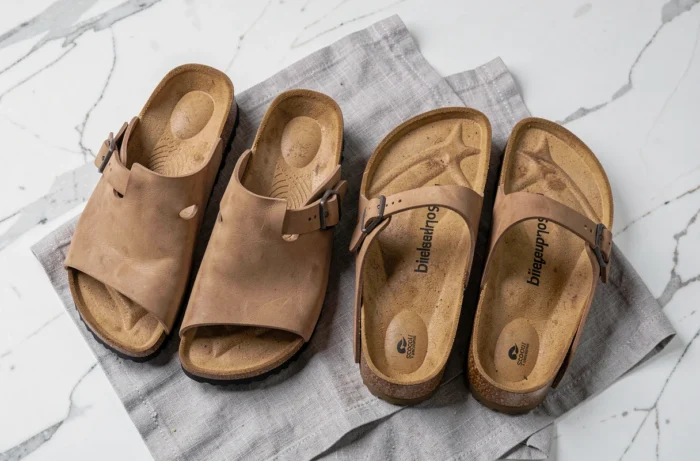
The Birkenstock cork-latex sole stands out for its ability to gradually conform to the foot’s morphology. Cork, a rigid material at first, molds with use to fit natural pressure points. This initial rigidity requires a break-in period that some users find uncomfortable in the first few days.
Scholl offers several types of soles depending on the collections. The Pescura models, for example, use a wooden base with a central joint that promotes foot movement while walking. Other ranges incorporate softer technical foams from the first wear.
What Podiatrists Say About Foot Support
Several podiatrists and orthopedic surgeons now present Birkenstock not as a treatment shoe, but as a replacement for barefoot indoors, suitable for pain types like plantar fasciitis or flexible flat feet. The support remains limited compared to a structured sports shoe with a more pronounced sole drop.
An article from EatingWell in 2026, based on orthopedic surgeons’ opinions, confirms that a sole drop of about 10 mm in a running shoe is often more effective for plantar fasciitis. The comfort sandal, regardless of the brand, does not replace a custom orthotic for advanced pathologies.
- Birkenstock: passive support through gradual molding of cork, suitable for moderate daily use and indoor walking
- Scholl (Pescura range): wooden joint that engages the foot muscles while walking, dynamic effect rather than static
- For diagnosed plantar fasciitis, both brands work better in conjunction with orthotics, not as replacements
Leather, Cork, or Wood: Real Durability of Scholl and Birkenstock Materials
The Birkenstock cork offers recognized longevity provided it is maintained. Prolonged exposure to water or heat dries out the cork and causes cracking. The brand recommends regular application of a conditioning product, which represents a maintenance cost that buyers often underestimate.
The leather used on models like the Arizona (one of Birkenstock’s best-selling models) ages well if the straps are not overly stressed. However, the heel of the footbed wears visibly after several seasons of intensive use.
Scholl Materials and Their Aging
The wooden soles of the Pescura have superior mechanical strength compared to cork, but comfort decreases if the upper covering (leather or textile) deteriorates. Scholl models with technical foam lose their cushioning ability more quickly than a well-maintained cork footbed.
- Birkenstock Cork: long lifespan with maintenance, sensitive to moisture, replaceable sole on some models
- Scholl Wood (Pescura): sturdy structure but more fragile covering, no standard resoling offered
- Scholl Foam: immediate comfort but significant loss of cushioning after a few months of daily use
Choosing Between Scholl and Birkenstock Based on Daily Use
For primarily indoor use (home, office), Birkenstock works as an alternative to barefoot with better support than a classic slipper. The Arizona model, with its two adjustable straps, remains the reference for this use.
For professionals who spend the day on their feet (health, hospitality, retail), Scholl mules like the Pescura provide a dynamic effect while walking thanks to their articulated sole. This movement engages the foot muscles more, which can reduce fatigue over extended periods.
Outdoors and over longer distances, neither brand replaces a structured walking shoe. The limited drop of Birkenstock and Scholl sandals is suitable for short trips, not for hiking.
The choice often comes down to a preference for sensation: progressive rigidity and natural molding on the Birkenstock side, immediate flexibility and dynamism on the Scholl side. Feet sensitive to hard pressure points will adapt better to Scholl foams from the first wear, while those seeking durable support over several seasons will find satisfaction with Birkenstock cork, provided they accept the initial break-in.